
[2-minute Read]
Is FlutterFlow a no code tool? Or is it a Low Code tool? Well, neither of those terms truly does FlutterFlow justice, because FlutterFlow is a "visual development platform". Over 3.3M users build with it today, and it comes with 1,000+ prebuilt templates and 200+ pre-designed UI elements.
Source: FlutterFlow – Pricing
Source: FlutterFlow – Build Beautiful, Modern Apps
It offers a balanced approach between ease of use and customization by providing a low-abstraction interface that allows developers to build complex applications with a visual, intuitive workflow while still exposing the underlying Flutter framework. In other words, the visual editor never hides the real Flutter app underneath it.
What Makes FlutterFlow a Visual Development Platform
- Visual Interface: The platform allows developers to visually select and modify app components in real-time.
- Core Setup: FlutterFlow automates repetitive tasks like setting up authentication and routing, freeing developers to focus on customization.
- Collaboration and Deployment: With seamless web-based collaboration and powerful deployment options, developers can easily share and deploy their work across platforms.
- Developer Enhancements: The platform enhances Flutter's capabilities, like supporting enums and automatic schema generation.
- Control and Ownership: FlutterFlow gives developers fine-grained control over app properties and ensures they retain ownership of their code.
Taken together, these points describe a tool made for developers rather than one that replaces them: the repetitive setup is automated, while the decisions about how the app behaves stay in the developer's hands, and so does the code.
The Misconception of No-Code
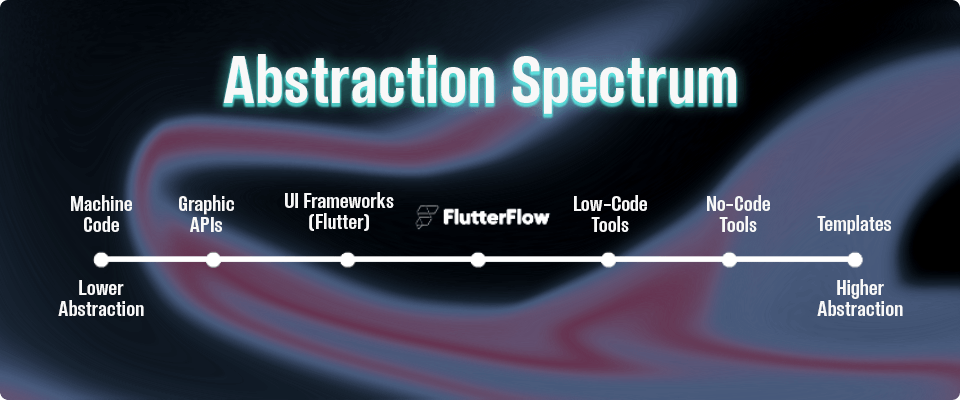
Critics often argue that no-code tools produce inefficient, non-scalable applications with limited customization. However, FlutterFlow challenges this notion by positioning itself in the middle of the abstraction spectrum. It balances ease of use with depth of customization, allowing developers to harness both high-level efficiency and low-level control.
So is FlutterFlow no-code or low-code?
The answer depends on where a tool sits on the abstraction spectrum, and FlutterFlow sits in a place of its own:
- Low abstraction (machine code, platform APIs): great performance and deep customization, but slow and a pain to work with.
- High abstraction (typical no-code tools): easy to use, but short on customization and scalability.
- FlutterFlow, in the middle: granular control over the app, with the ease of use of a visual development interface.
It reaps the benefits of both ends. That is why calling it "no-code" undersells it, and calling it "low-code" misses how much of the work happens visually.
Conclusion
FlutterFlow isn't just a tool; it's part of a broader movement towards more accessible, yet powerful, app development platforms. Technology always evolves and progresses forward. Just as we transitioned from command line interfaces to graphical user interfaces (GUIs) to make computing more intuitive, FlutterFlow represents the next evolution in app development.
It is redefining what it means to build software by providing a bridge between the traditional code-heavy methods and the more abstract, less customizable no-code solutions.
That middle ground, between hand-written code and closed no-code builders, is where FlutterFlow sits.
Source: