AI is already part of the daily workflow for many businesses. Teams use ChatGPT and other AI tools to draft emails, summarize documents, analyze information, generate content, brainstorm ideas, and speed up routine tasks.
These tools are useful, but they all depend on the same thing: someone has to start the work. A person opens the tool, gives it context, writes a prompt, reviews the result, and decides what happens next. The AI helps, but the person is still running the process.
An AI agent changes that relationship. Instead of waiting for someone to tell it what to do every time, an agent can monitor what is happening, decide when something needs attention, and take approved action based on the goals and rules your business has given it.
Basically, an AI tool helps you do the work. An AI agent can help make sure the work happens.
An AI tool is something a person actively operates. You open it, explain what you need, provide the relevant information, and ask it to help with a specific task.
That could mean writing a proposal, summarizing a report, generating ideas for a campaign, analyzing a spreadsheet, drafting a customer response, or helping a developer write code. The value is obvious: the tool can make a person faster and reduce the amount of manual effort required to complete a task.
But the tool is still passive.
If a new lead enters your CRM at midnight, the AI tool does not notice. If an important support request arrives while your team is offline, it does not react. If a customer who normally orders every month suddenly disappears, it does not automatically investigate what changed.
It only becomes useful when somebody opens it and asks.
That means the AI may be helping with the task, but the human is still responsible for noticing that the task needs to happen in the first place.
An AI agent is designed to operate with more independence. Instead of waiting for a person to initiate every task, it can be connected to the systems where work is already happening, such as your CRM, inbox, support platform, internal software, or database.
From there, the agent can monitor what is happening, evaluate what it sees against the goals and rules you have defined, and take an approved action when the situation calls for it.
For example, a sales agent might notice that a new lead has arrived, check whether the company matches your qualification criteria, look at the information already in your CRM, and determine the appropriate next step.
A support agent might monitor incoming requests, identify which ones are routine, respond to the ones it is allowed to handle, and escalate urgent cases that need a person.
A retention agent might notice that a previously active customer has suddenly gone quiet and trigger the appropriate follow-up before the relationship disappears completely.
The important difference is that the AI is no longer waiting for someone to tell it, “Please look at this.”
It is already paying attention to the job it has been given.
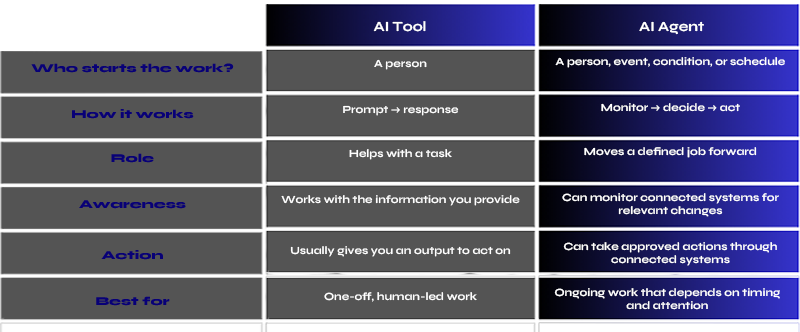
The practical difference is simple: a tool makes the person doing the task faster. An agent reduces how often a person needs to be there for the task to move forward at all.
It is easy to assume that AI agents are simply more intelligent versions of the AI tools people already use. That is not really the point.
A normal AI tool can already write an excellent email, summarize a complicated report, analyze information, or suggest what you should do next. An agent may use similar underlying AI capabilities.
What changes is what happens around that intelligence.
A tool waits for input. An agent can be given a job.
That job could be watching for new leads and making sure each one receives the right next step. It could be monitoring support requests and surfacing urgent issues quickly. It could be tracking customer activity and flagging accounts that may need attention.
You are no longer asking AI to help with isolated moments. You are defining a job and allowing the system to keep that work moving within the boundaries you have set.
That is why we often describe the shift like this:
It is not just another tool you have to run. It is a teammate that can run the work for you.
Consider a simple situation. A new lead enters your website at 11:40 PM.
With an AI tool, nothing happens automatically. The next morning, someone notices the lead, opens the AI tool, pastes in the relevant information, asks it to draft a reply, reviews the response, and sends it. The AI helped, but the whole process still depended on a person noticing the lead and starting the work.
With an AI agent, the process can be different. The agent sees the new lead when it arrives, checks it against the criteria your business has defined, looks at the relevant context, and decides what should happen next. Depending on the rules you set, it might send an approved response, assign the lead to the right person, update the CRM, or escalate it for review.
By the time the team comes online, the opportunity may already be moving.
Now imagine a long-time customer slowly becoming inactive. A normal AI tool does nothing because nobody has asked it to look at the account.
An agent can detect that the customer’s behavior has changed, compare it against the signals your business considers important, and trigger a follow-up or alert the account owner before the relationship goes cold.
The value in both examples is not that AI can write an email. AI tools can already do that.
The value is that the system can notice when the email needs to exist in the first place.
This same pattern appears across sales, customer support, operations, account management, internal reporting, and many other areas of a business. Wherever important work depends on somebody constantly watching for the right moment to act, an agent can become useful.
At NeWwave, we build personalized AI agents around real business workflows, systems, goals, and operating rules.
If you already have a process where leads are slipping, responses are delayed, teams are constantly monitoring systems, or work stops whenever nobody is watching, we can help determine whether an AI agent is the right solution.
Talk to NeWwave about AI agents →
Subscribe to the NeWwave’s Newsletter for practical breakdowns on AI automation, integration, custom AI, autonomous agents, and how these technologies and software can be applied to real business problems.
Subscribe to the NeWwave newsletter →

.png)