%20(1).png)
Almost every business owner has now tried an off-the-shelf AI tool. You've pasted a prompt into ChatGPT, generated a caption, maybe drafted a proposal. It felt like magic for about a week. Then the cracks showed: the tone was never quite yours, it didn't know your products, and every task started almost from zero, re-explaining your business again and again.
That gap between a generic tool and something built for you is exactly what this piece is about. Off-the-shelf AI is a starting line, not a finish line. Custom generative AI is what happens when the intelligence is trained on your business, speaks in your voice, and produces work you can actually ship. Below is a straight comparison, a simple way to decide which one you need, and the real outcomes custom generative AI delivers.
Generative AI creates new things: text, images, video, code, rather than just sorting or routing information. A generic AI tool does this for everyone in general. Custom generative AI does it for your business specifically.

The difference isn't the underlying model. It's the context. A custom solution is trained and grounded on your catalog, your brand voice, your past proposals, your customer language, and your rules for what "on-brand" means. So instead of a clever assistant that knows a little about everything, you get a system that knows your business deeply and produces output that's ready to use, not ready to be heavily edited.
Think of the off-the-shelf tool (ChatGPT, Gemini, DeepSeek) as a talented freelancer you re-brief every single morning. Custom generative AI is the in-house specialist who already knows the brand book, the product line, and how you like things done.
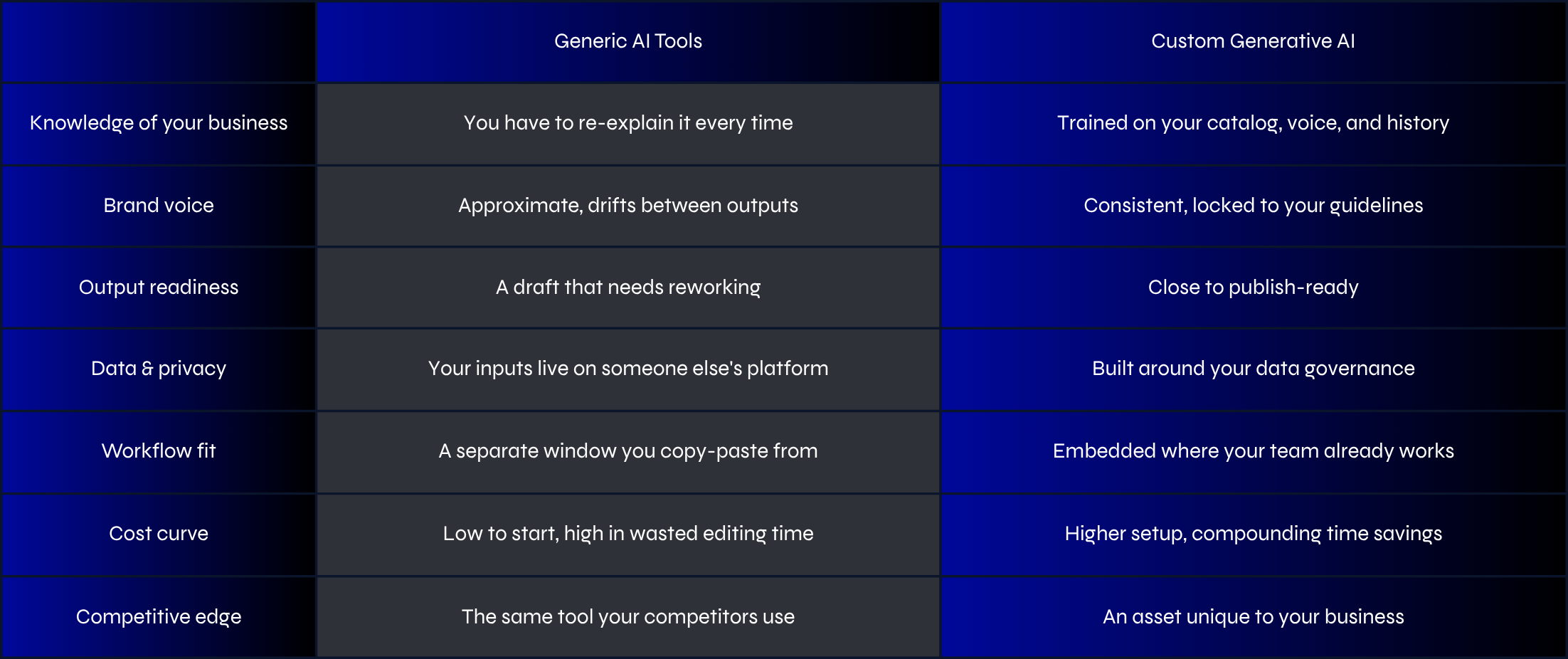
The pattern is clear. Generic AI wins on speed-to-first-try. Custom wins on everything that matters once AI becomes part of how you actually operate.
Only in one situation: when you're not really running a business on it. A generic tool does the job for a student, a hobbyist, or anyone using AI for the occasional one-off, a quick brainstorm, a rough draft, a task where brand, privacy, and consistency simply don't matter and no one else sees the output.

The moment you're a company, that calculation flips almost entirely. You have a brand to protect, customers who expect consistency, sensitive data you can't paste into a public tool, and work that repeats every single day. At that point a business is overwhelmingly better off with custom generative AI. Off-the-shelf tool will keep feeling almost right and "almost right," repeated across every caption, proposal, and customer reply, is exactly what quietly drains your time, your consistency, and your edge. If you run a real business, the honest answer is that a generic tool is a stopgap, not a solution.
The signs are consistent across the SMEs we work with:
If three or more of those ring true, you're not looking for a better prompt. You're looking for a system built around your business.
This is where it stops being theory. Here are the deployable use cases that deliver value fastest for SMEs or even large enterprises.
1. A brand-voice chatbot trained on your catalog. Not a generic FAQ bot, an assistant that knows every product, price, and policy, and answers customers in your tone, day and night. It handles the repetitive questions that flood your inbox so your team can focus on the conversations that close deals.
2. On-brand content generation at scale. Captions, product descriptions, ad copy, even first-draft proposals; all generated in your voice, aligned to your guidelines, ready for a quick human polish instead of a full rewrite. The bottleneck stops being "who has time to write this" and becomes "which of these do we ship."
3. An internal document-search assistant. Every SOP, contract, spec, and past project becomes instantly answerable in plain language. New hires get up to speed faster, and your team stops digging through folders to find the one file they need.
Each of these produces new work, that's what makes it generative, and that's what separates Pillar 3 from the automation and lead-intelligence work in our earlier pillars.
This is the objection that keeps most SMEs on generic tools longer than they should be. It used to be true. It isn't anymore.
.png)
Modern development moves dramatically faster than the old custom-software timeline. We routinely build up to 70% faster than a traditional approach. That collapses the cost and the wait that used to make "custom" feel out of reach for a small business. The result is that an SME can now own a generative AI asset that, two years ago, only a large enterprise could afford.
And the cost comparison isn't setup-fee vs. free. It's setup-fee vs. the compounding hours your team burns editing off-brand output, re-explaining context, and copy-pasting between tools. Custom AI pays that back every week it runs.
You don't rebuild everything at once. The smart path is to pick the single highest-friction task in your business and build one custom generative AI solution around it. Prove the value, then expand.
That's the approach behind the whole NeWwave AI Transformation Series: automation first (Pillar 1), integration into your systems (Pillar 2), custom generative AI built for you (Pillar 3), and autonomous agents that run on their own (Pillar 4). Each pillar builds on the last, and custom generative AI is where the work starts sounding, looking, and feeling unmistakably like your business.
Is custom generative AI just ChatGPT with extra steps?
No. It uses similar underlying models, but it's grounded on your catalog, brand voice, and business rules; so the output is specific to you and close to publish-ready, instead of generic and needing a rewrite.
Do I need to replace the AI tools my team already uses?
Not necessarily. Off-the-shelf tools are fine for low-stakes, one-off tasks. Custom generative AI makes sense once you're producing at volume, brand consistency matters, or sensitive data is involved.
How is Pillar 3 (Custom Generative AI) different from AI automation and integration?
Automation routes and triggers actions; integration connects AI to your ERP/CRM and existing systems. Generative AI creates new content and assets — captions, proposals, images, chatbot responses, all in your voice.
Is custom AI realistic for SMEs?
Yes. Building up to 70% faster than traditional development has collapsed the cost and timeline, putting custom generative AI within reach of SMEs, not just enterprises.
If you run a business and any of this sounds like the gap you've been feeling, this is the moment to act. We build custom generative AI trained on your business, in your voice, and deployed where your team already works, and we're leading this shift across Southeast Asia.
Book a free 30-minute discovery call, and we'll map the single highest-value AI opportunity in your business. Contact us now at new-wave.io.
.png)

.png)